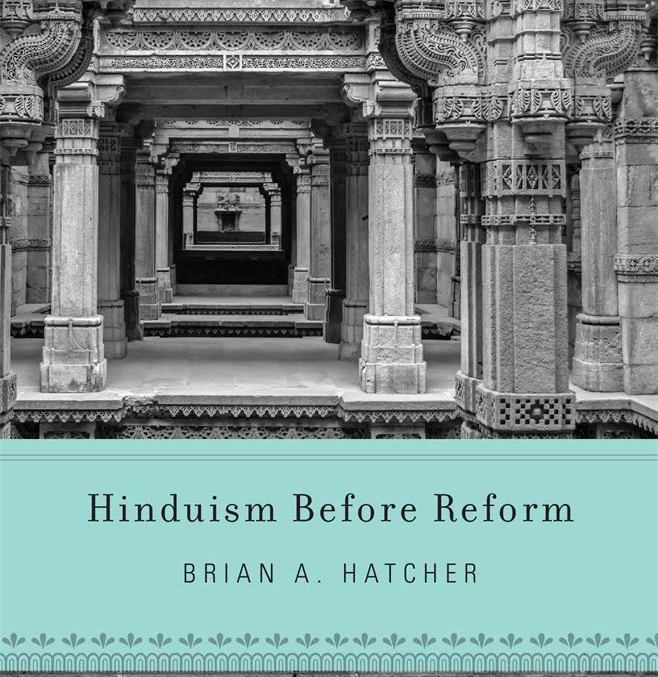
Brian Hatcher's 'Hinduism Before Reform' sketches radical view of contemporary Hinduism
Kolkata/UNI: Tufts University Professor Brian A. Hatcher's latest book 'Hinduism Before Reform' sketches a radical new view of the origins of contemporary Hinduism and overturns the idea of religious reform.
By the early eighteenth century, the Mughal Empire was in decline and the East India Company was making inroads into the subcontinent.
A century later Christian missionaries, Hindu teachers, Muslim saints and Sikh rebels formed the colorful religious fabric of colonial India.
Focusing on two Hindu communities, the Brahmo Samaj and the Swaminarayan Sampraday and their charismatic figureheads--the “cosmopolitan” Rammohun Roy and the “parochial” Swami Narayan--Brian Hatcher explores how urban and rural people thought about faith, ritual and gods, publisher HarperCollins said in an emailed statement to UNI here.
Along the way Hatcher, who holds the the Packard Chair of Theology at Tufts University, sketches a radical new view of the origins of contemporary Hinduism and overturns the idea of religious reform.
'Hinduism Before Reform' challenges the rigid structure of revelation-schism-reform-sec prevalent in much of the history of religion. Reform, in particular, plays an important role in how one thinks about influential Hindu movements and religious history at large.
Through the lens of reform, one doctrine is inevitably backward looking while another represents modernity. From this comparison flows a host of simplistic conclusions. Instead of presuming a clear dichotomy between backward and modern, Hatcher is interested in how religious authority is acquired and projected.
The book dwells on how religious history would look if we eschewed the obfuscating binary of progress and tradition. There is another way to conceptualize the origins and significance of these two Hindu movements--one that does not trap them within the teleology of a predetermined modernity.
Brian A. Hatcher's previous books include Bourgeois Hinduism and Vidyasagar: The Life and After-life of an Eminent Indian.
The hardback 366-page book, priced at Rs 699, has been published by Harvard University Press. It is represented in India by HarperCollins Publishers India, the statement said.
Keywords:
Support Our Journalism
We cannot do without you.. your contribution supports unbiased journalism
IBNS is not driven by any ism- not wokeism, not racism, not skewed secularism, not hyper right-wing or left liberal ideals, nor by any hardline religious beliefs or hyper nationalism. We want to serve you good old objective news, as they are. We do not judge or preach. We let people decide for themselves. We only try to present factual and well-sourced news.
Support objective journalism for a small contribution.