


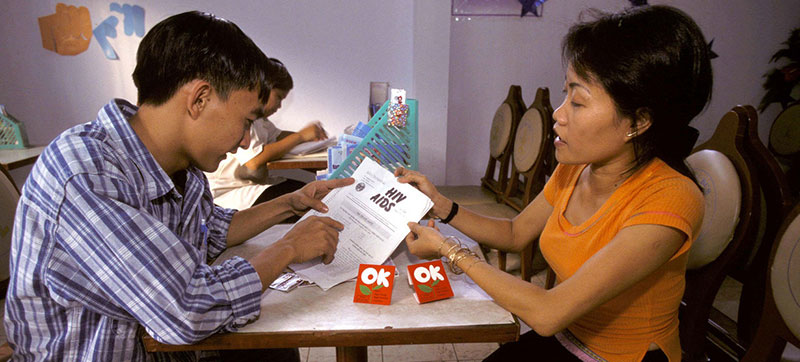
 HIV-AIDS
Workers with HIV-AIDS continue to face stigma, discrimination: ILO
New York: “Myths and misconceptions” about HIV and AIDS continue to fuel stigma and discrimination in the workplace, the International Labour Organization (ILO) said on Tuesday.
Despite some improvement in people’s tolerance to the disease in the more than 40 years since the AIDS epidemic began, a survey of 55,000 people in 50 countries found that only one in two people knew that HIV cannot be transmitted by sharing a bathroom.
“It is shocking that, 40 years into the HIV and AIDS epidemic, myths and misconceptions are still so widespread,” said Chidi King, head of ILO’s Gender, Equality, Diversity and Inclusion Branch.
Wake-up call
“A lack of basic facts about how HIV is transmitted is fuelling stigma and discrimination. This survey is a wake-up call to reinvigorate HIV prevention and education programmes; the world of work has a key role to play.”
Stigma and discrimination in the workplace marginalize people, pushing those with HIV into poverty, Ms. King maintained.
Working with opinion poll company Gallup, the ILO Global HIV Discrimination in the World of Work Survey reveals that discriminatory attitudes are fuelled by a lack of knowledge about HIV transmission.
At the end of 2020, approximately 38 million people globally were living with HIV, with 1.5 million newly infected that year, and approximately 680,000 people dying from AIDS- related illnesses, according to the survey. Despite progress made on combating stigma, the coronavirus pandemic has exacerbated the situation.
Care burdens
“The COVID-19 pandemic has certainly pushed back some of the efforts, some of the progress that had been made towards eradicating HIV, and there is an even more urgent need now to double those efforts,” Ms. King said.
“In terms of the impact on people affected by HIV, not only people living with HIV but people who may be looking after somebody with HIV…care burdens have increased during the pandemic due to the non-availability of certain services, therefore seeing a disproportionate impact in relation to women in particular, and in some instances, girls as well."
Asia and Pacific in spotlight
The survey noted that the lowest tolerance for working directly with people with HIV was found in Asia and the Pacific, followed by the Middle East and North Africa.
The regions with the most positive attitudes were Eastern and Southern Africa, where almost 90 per cent of respondents said they would be comfortable working directly with people with HIV.
Higher educational levels were also associated with positive attitudes towards working with those living with HIV.
The report also offered a number of recommendations, including implementation of HIV programmes to increase awareness of modes of transmission and to improving the legal and policy environment around HIV to protect rights of workers.
“The workplace has a key role in this education,” Ms. King told journalists in Geneva. “Workers and employers certainly have a role to play. Social dialogue is a key mechanism through which they can craft policies and materials and products in order to raise awareness, ensuring that recruitment policies do not discriminate against people with HIV/AIDS. Governments also have a role to play in terms of broader engagement.”
Confronting inequalities and ending discrimination is critical to ending AIDS, the report said, particularly during the ongoing COVID pandemic.
Support Our Journalism
We cannot do without you.. your contribution supports unbiased journalism
IBNS is not driven by any ism- not wokeism, not racism, not skewed secularism, not hyper right-wing or left liberal ideals, nor by any hardline religious beliefs or hyper nationalism. We want to serve you good old objective news, as they are. We do not judge or preach. We let people decide for themselves. We only try to present factual and well-sourced news.
Support objective journalism for a small contribution.


