


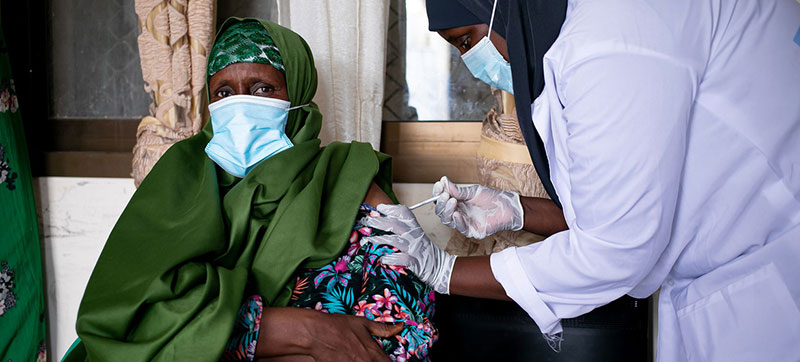
 Omicron
Omicron: Don't panic but prepare for likely spread, says WHO
New York: As scientists continue to investigate the Omicron COVID-19 variant, the UN World Health Organization (WHO) on Friday urged countries not to panic but to prepare for its likely spread.
Heralding South Africa’s and Botswana’s decision to report the appearance of the Omicron coronavirus mutation last month, the UN health agency repeated that it will take another two weeks before more is known about how transmissible and how dangerous it actually is.
Speaking in Geneva, WHO spokesperson Christian Lindmeier stressed that data suggesting that Omicron was highly transmissible was only preliminary.
Unnecessary travel bans
He also repeated WHO advice against blanket travel bans, except for countries whose health systems were unable to withstand a surge in infections.
“It is much more preferred to prepare your country, your health system to possibly incoming cases because we can be pretty sure that this Omicron variant will spread around,” he said.
The Delta mutation – declared a variant of concern this summer – is now “predominant”, Mr. Lindmeier added, “with over 90 per cent all around the world. This is how this virus behaves and we will not most likely be able to keep it out of individual countries.”
The WHO official also cautioned against knee-jerk reactions to reports that Omicron had continued to spread.
“Let’s not get deterred right now, let us first get as much information as possible to make the correct risk assessment based on the information that we will have and then let’s move on,” he said.
“Let’s not get completely worried or confused by individual information which are all individually important, but which need to be brought together in order to assess together.”
Surge team for South Africa spike
The development comes as WHO said that it was sending a technical surge team to South Africa’s Gauteng province to monitor Omicron and help with contract tracing, amid a spike in coronavirus reinfections.
For the seven days leading to 30 November, South Africa reported a 311 per cent increase in new cases, compared with the previous seven days, WHO said on Thursday.
Cases in Gauteng province, where Johannesburg is located, have increased by 375 per cent week on week. Hospital admissions there rose 4.2 per cent in the past seven days from the previous week. And COVID-19-related deaths in the province jumped 28.6 per cent from the previous seven days.
Announcing the surge team deployment, Dr Salam Gueye, WHO Regional Emergency Director for Africa, noted that just 102 million Africans in Africa – 7.5 per cent of the continental population – are now fully vaccinated and that more than 80 per cent of the population has not received even a single dose. “This is a dangerously wide gap,” he said.
In a statement, WHO said that South Africa is reportedly seeing more patients contracting COVID-19 after having already been infected, in a way it did not with previous variants, citing a microbiologist from the country’s National Institute for Communicable Diseases (NICD).
Working with African governments to accelerate studies and bolster the response to the new variant, the World Health Organization (WHO) is urging countries to sequence between 75 and 150 samples weekly.
Detection ‘bought the world time’
“The detection and timely reporting of the new variant by Botswana and South Africa has bought the world time,” said Dr Matshidiso Moeti, WHO Regional Director for Africa.
“We have a window of opportunity but must act quickly and ramp up detection and prevention measures. Countries must adjust their COVID-19 response and stop a surge in cases from sweeping across Africa and possibly overwhelming already-stretched health facilities.”
Support Our Journalism
We cannot do without you.. your contribution supports unbiased journalism
IBNS is not driven by any ism- not wokeism, not racism, not skewed secularism, not hyper right-wing or left liberal ideals, nor by any hardline religious beliefs or hyper nationalism. We want to serve you good old objective news, as they are. We do not judge or preach. We let people decide for themselves. We only try to present factual and well-sourced news.
Support objective journalism for a small contribution.


