


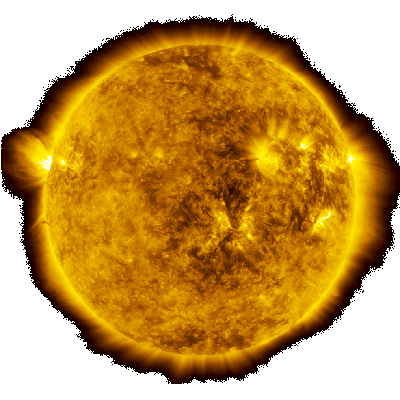
NASA’s SDO sees partial eclipse in space
The lunar transit lasted almost an hour, between 2:24 and 3:17 p.m. EDT, with the moon covering about 89 percent of the sun at the peak of its journey across the sun’s face, read the NASA website.
The moon’s crisp horizon can be seen from this view because the moon has no atmosphere to distort the sunlight.
While the moon’s edge appears smooth in these images, it’s actually quite uneven.
The surface of the moon is rugged, sprinkled with craters, valleys and mountains.
Later this summer on Aug. 21, 2017, SDO will witness another lunar transit, but the moon will only barely hide part of the sun. However, on the same day, a total eclipse will be observable from the ground.
A total solar eclipse — in which the moon completely obscures the sun — will cross the United States on a 70-mile-wide ribbon of land stretching from Oregon to South Carolina.
Throughout the rest of North America — and even in parts of South America, Africa, Europe and Asia — a partial eclipse will be visible.
The moon’s rough, craggy terrain influences what we see on Earth during a total solar eclipse.
Light rays stream through lunar valleys along the moon’s horizon and form Baily’s beads, bright points of light that signal the beginning and end of totality.
The moon’s surface also shapes the shadow, called the umbra, that races across the path of totality: Sunlight peeks through valleys and around mountains, adding edges to the umbra.
These edges warp even more as they pass over Earth’s own mountain ranges. Visualizers used data from NASA’s Lunar Reconnaissance Orbiter, or LRO, coupled with NASA topographical data of Earth, to precisely map the upcoming eclipse in unprecedented detail. This work shows the umbral shape varies with time, and is not simply an ellipse, but an irregular polygon with slightly curved edges.
LRO is currently at the moon gathering data and revolutionizing our understanding of Earth’s nearest celestial neighbor.
Knowing the shape of Earth and the moon plays a big part in accurately predicting the umbra’s shape as it falls on Earth, come Aug. 21.
SDO will see its partial eclipse in space just after the total eclipse exits the United States.
Image Credits: NASA’s Goddard Space Flight Center/SDO/Joy Ng, producer
Support Our Journalism
We cannot do without you.. your contribution supports unbiased journalism
IBNS is not driven by any ism- not wokeism, not racism, not skewed secularism, not hyper right-wing or left liberal ideals, nor by any hardline religious beliefs or hyper nationalism. We want to serve you good old objective news, as they are. We do not judge or preach. We let people decide for themselves. We only try to present factual and well-sourced news.
Support objective journalism for a small contribution.


