


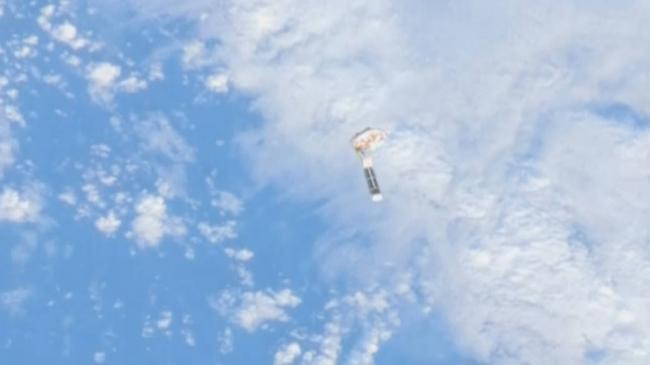
NASA to test advanced space wireless network and device for returning small spacecraft to Earth
Washington,Nov 25 (IBNS): NASA launched the Technology Educational Satellite, or TechEdSat-6, to the International Space Station on Orbital ATK’s Cygnus spacecraft from NASA’s Wallops Flight Facility in Virginia on Nov. 12.
This bread loaf-sized satellite is part of a continuing series to demonstrate the "Exo-Brake" parachute device, advanced communications and wireless sensor networks.
TechEdSat-6 was released into low-Earth orbit from the NanoRacks platform on Nov. 20, to begin a series of wireless sensor experiments which will be the first self-powered tests, expanding the capabilities of sensor networks for future ascent or re-entry systems.
This is the fourth TechEdSat satellite carrying an updated version of the Exo-Brake that will demonstrate guided controlled re-entry of small spacecraft to safely return science experiments from space, read the NASA website.
“The Exo-Brake’s shape can be changed to vary the drag on the satellite. With the help of high-fidelity simulations, we will demonstrate a low-cost, propellant-less method of returning small payloads quickly, and to fairly precise locations, for retrieval,” said Michelle Munk, NASA’s System Capability Lead for Entry, Descent and Landing. “We are excited about tracking TechEdSat-6 as it re-enters the atmosphere.”
While the goal of returning samples from the space station and orbital platforms is integral to the project, NASA seeks to develop building blocks for larger-scale systems that might enable future small spacecraft missions to reach the surface of Mars and other places in the solar system.
The Exo-Brake is funded by the Entry Systems Modeling project within the Space Technology Mission Directorate’s Game Changing Development program. Additional funding for the Exo-Brake is provided by NASA's Ames Research Center in California's Silicon Valley and the agency's Engineering and Safety Center in Hampton, Virginia.
The TechEdSat series is a science, technology, engineering and math, or STEM, collaborative activity that involves NASA early-career employees, interns and students from several universities including San Jose State University, California; the University of Idaho in Moscow; the University of California at Riverside; California Polytechnic State University, San Luis Obispo; the University of Georgia in Athens; and Smith College in Northampton, Massachusetts.
Image: NASA website
Support Our Journalism
We cannot do without you.. your contribution supports unbiased journalism
IBNS is not driven by any ism- not wokeism, not racism, not skewed secularism, not hyper right-wing or left liberal ideals, nor by any hardline religious beliefs or hyper nationalism. We want to serve you good old objective news, as they are. We do not judge or preach. We let people decide for themselves. We only try to present factual and well-sourced news.
Support objective journalism for a small contribution.


