


NASA Supercomputer simulations help improve aircraft propulsion design
One concept studied at NASA’s Ames Research Center, in California’s Silicon Valley, is the contra-rotating open rotor propulsion system, which has two ultra-thin blades spinning in opposite directions on the same shaft, similar to the blades on a giant kitchen blender.
"These contra-rotating blades rotate around the outside of a turbofan jet engine, like that commonly used in modern airliners. This unique design allows air to flow more efficiently through the turbofan blades to improve flight performance, reduce carbon emissions and decrease blade rotation noise," the NASA website said.
For the past year, researchers at the NASA Advanced Supercomputing (NAS) facility at Ames have produced first-of-a kind simulations of sound produced by air – aeroacoustics – to reliably predict noise sources for contra-rotating open rotors.
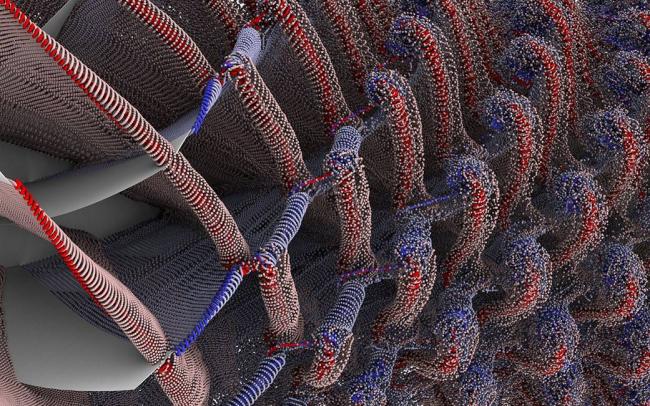
The image was generated from a computer simulation of a contra-rotating, open-rotor design in which red particles are “released” on the upstream blades, blue on the aft blades.
Solid colors are released on the blade tips, while faded colors are on the blade trailing edges. The basket-weave pattern shows where particles interact with each other — one of the sources of blade noise.
Using computational fluid dynamics methods and the Pleiades supercomputer, the NAS team verified the simulation accuracy and compared sound pressure level ranges with extensive wind tunnel test data from NASA’s Glenn Research Center and General Electric.
The simulations and results matched closely with the wind tunnel test results for sounds produced by the rotating blades.
The analysis requires a massive amount of computing power and time. Currently, the NAS team is researching ways to speed up the simulation and analysis process and cut down on computing resources needed to design planes that are more Earth-friendly.
Image: NASA
Support Our Journalism
We cannot do without you.. your contribution supports unbiased journalism
IBNS is not driven by any ism- not wokeism, not racism, not skewed secularism, not hyper right-wing or left liberal ideals, nor by any hardline religious beliefs or hyper nationalism. We want to serve you good old objective news, as they are. We do not judge or preach. We let people decide for themselves. We only try to present factual and well-sourced news.
Support objective journalism for a small contribution.


