


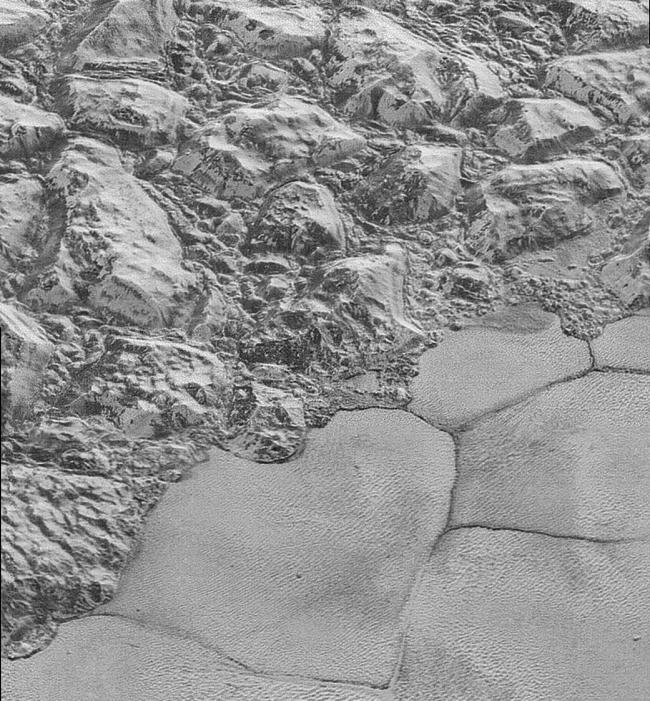
Icy dunes on Pluto reveal a diverse and dynamic dwarf planet
Washington, June 9 (IBNS): Newly discovered dunes on Pluto tell us the dwarf planet’s geology and atmosphere is far more dynamic than previously expected, with the winds of its thin and multi-layer atmosphere helping shape the landscape.
Found near the mountains that encircle Pluto’s Sputnik Planitia plain, these formations appear to be quite young in geological terms, on the scale of decades or centuries old.
NASA New Horizon’s scientists found these evenly spaced ridges on Pluto’s surface using imagery from the 2015 flyby, read the NASA website.
The ridges appear to have formed out of particles of methane ice as small as grains of sand, arranged into dunes by wind from the nearby mountains.
Wind can create dunes through a process known as eolian transport, where winds move sediment by skipping, bouncing, rolling and sliding particles across the ground.
However, the winds on Pluto aren’t strong enough on their own to loft these grains off the ground.
But the process of sublimation – where ice turns straight into gas, without going through the liquid phase – also lifts particles and could dislodge the sediment carried by winds to form these methane rich dunes.
“The interesting, repeating patterns we see covering this part of Sputnik Planitia certainly resemble dunes,” said Jeffery Moore, a research scientist at NASA’s Ames Research Center in Silicon Valley, and author on a June 1st paper that appeared in Science. “But they might also be sublimation erosion patterns, or due to a combination of particle movement and sublimation erosion.”
The existence of young dune formations on Pluto tells us that all these complex systems are at play in this dynamic dwarf planet. The New Horizons data is showing a geologically vibrant surface, sparking continuous discussion among the scientific community.
“More research will help us pin down their origin,” said Jeff. “Whatever they are, it’s clear Pluto is one of the most amazing and complex objects in our solar system.”
Support Our Journalism
We cannot do without you.. your contribution supports unbiased journalism
IBNS is not driven by any ism- not wokeism, not racism, not skewed secularism, not hyper right-wing or left liberal ideals, nor by any hardline religious beliefs or hyper nationalism. We want to serve you good old objective news, as they are. We do not judge or preach. We let people decide for themselves. We only try to present factual and well-sourced news.
Support objective journalism for a small contribution.


